Displaying customer reviews on your website responsibly means making clear where opinions came from, what they refer to, and how they were selected. This guide covers practical steps for choosing sources, adding context, moderating consistently, and checking publication rights—so reviews inform visitors without creating an impression the available evidence does not support.
- Identify the source and context: Make clear who supplied a review, what it refers to, and how it was collected.
- Moderate according to explicit rules: Apply consistent criteria and do not remove opinions simply because they are critical.
- Explain aggregate ratings: Show the number of ratings, the scale, and any relevant time period.
- Check permissions and personal data: Confirm that you may publish the review and any associated name, photograph, or other identifying information.
What transparent review presentation means
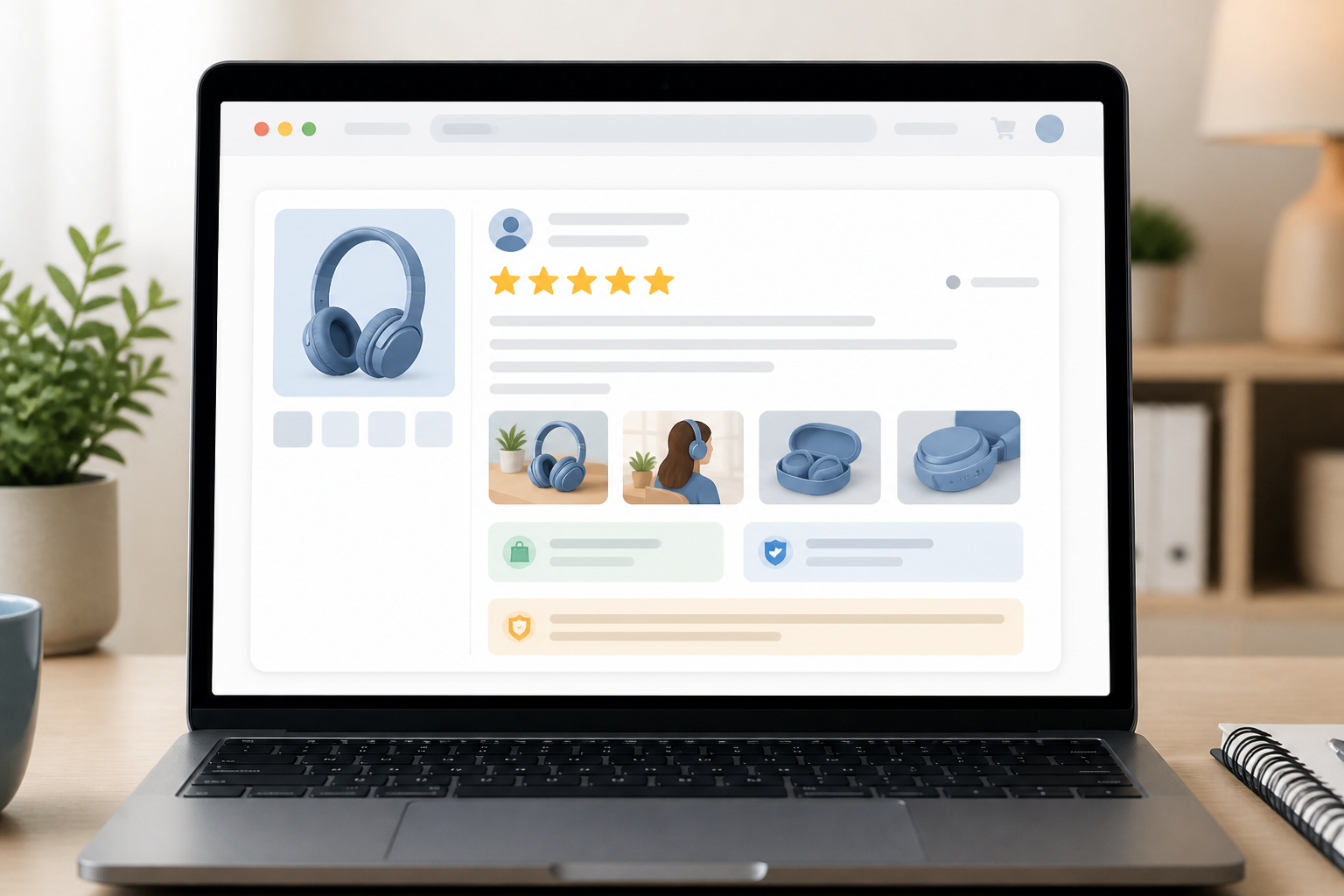
Displaying customer reviews on your website responsibly means making it clear where opinions came from, what they refer to, and how they were selected. For a business, this involves more than adding stars: it requires moderation rules, permission checks, and an accurate presentation of ratings.
This guide explains how to choose a source, provide context, manage moderation, and check the interface. The aim is to inform visitors without creating an impression that the available evidence does not support.
Choose a source and explain it
The source determines what you can claim about authenticity and how much context to retain. Before implementation, distinguish reviews collected by your business from reviews displayed through an external service. Do not combine them into one feed without labels that explain where they came from.
Reviews collected directly
If you use a website form or send a request after purchase, record where and when the opinion was collected. Explain what may be published and what information will appear beside the review. Avoid publishing a full name or order details unless they are necessary.
A neutral request invites customers to describe their experience without asking for a positive rating. If a review arrived by email or in a private conversation, check whether it may be republished and under what conditions.
Reviews from external platforms
If you display reviews from a platform, identify it and retain relevant context. Check the platform’s terms and permitted method of reuse. A screenshot or manual copy can become outdated and may leave out important information.
If you use an integration tool, establish who maintains it and how often content is refreshed. Do not imply that your business verified every opinion if verification is performed by an external platform—or does not take place.
Keep an internal record of the source, collection date, associated product or service, and verification status. If a review is anonymized, say so and check that it does not still identify the person indirectly.
Present customer reviews with context
A review without context can seem more conclusive than it is. Adding context does not mean editing an opinion to change its meaning; it means providing verifiable details that help visitors interpret it.
Preserve the context of each rating
Show what was reviewed and when the opinion was written. For a service, the type of engagement may help; for a product, a relevant variant or feature may be useful if that information is known and can be published. Do not infer details the author did not provide.
If the opinion refers to a particular period or an earlier version of a product, say so when that matters to interpretation. This helps visitors avoid mistaking an older experience for the current situation.
Explain the aggregate score
If you show an average, display the number of ratings included and the scale used. Clarify whether the total covers a product, category, shop, or service. Without these details, a score such as 4 out of 5 leaves visitors guessing what it measures.
Set a rule for unrated opinions, duplicate ratings, and reviews removed later. If the score covers a limited period, state that period. Update the score when the review set changes and check that an outdated value has not been left on the page.
Disclose incentives and relevant relationships
If an author received a benefit for taking part in a feedback campaign, disclose it beside the review. The benefit must not depend on expressing a favorable opinion. A note hidden on a hard-to-find page does not help readers understand the review’s context.
- Use the same visual format for positive and critical reviews.
- Do not round or rephrase a rating in a way that changes its meaning.
Moderate without removing legitimate criticism
Moderation protects readers and authors, but it should not turn the review section into a collection of praise. The difference between moderation and misleading selection lies in the criteria you announce and apply consistently.
Define what can be moderated
Publish a moderation policy that is easy to find. You can specify that you remove spam, illegal content, abusive language, personal data posted accidentally, and messages unrelated to the product or service. Apply the same criteria to every opinion, regardless of its tone.
Do not delete a review merely because it expresses dissatisfaction or affects your business’s image. If a comment contains a factual issue, respond with verifiable information without rewriting the author’s opinion.
Edit carefully and keep a record
Correcting a formatting error is not the same as changing the meaning. If you need to remove personal data or a problematic passage, retain the rest only if it remains faithful to the original message and your policy allows this. Do not present an altered version as an unchanged, complete text.
Keep a minimal internal log of moderation decisions: what changed, why, and when. This helps the team apply the rules consistently and explain why a review did not appear if the author asks.
Respond without exposing private information
When responding to a negative review, acknowledge the issue described and offer a way to continue the conversation, where appropriate. Do not publish an order number, contact details, or private correspondence. Move case-specific checks to an appropriate channel and only share information publicly that you are entitled to disclose.
Make sure the person approving reviews can apply the moderation policy, rather than being guided only by the team’s commercial goals. If you reject a review, keep the reason internally and respond politely if the author asks for an explanation.
Choose a suitable location and format
The location and format of a review section affect how easily visitors can use the information. Reviews should support a decision, not interrupt it or obscure important terms.
Place reviews near the relevant decision
For a product, reviews can appear on that product’s page, after the information visitors need to understand the offer. For a service, testimonials may be useful on the service page or a dedicated page linked to the offer. Do not use the same generic endorsement as evidence for different services.
If you have many reviews, offer understandable filters, such as rating or period, and use an explainable sort order. If you show only reviews considered “most useful,” state the sorting criterion and provide a way to see other opinions.
Design the interface for mobile
On small screens, text should be readable without zooming, and filter and navigation controls should be easy to use. Do not hide the source, date, or incentive disclosure in an element that is difficult to notice. If text is truncated, offer a clear way to expand it.
Make sure star ratings also have a text equivalent for assistive technologies and that users do not have to distinguish ratings by color alone. Test the section with a keyboard and check the reading order.
Check that the component does not impair the experience
External widgets may add scripts, delay loading, or show content only after an action. Check the page on mobile and ordinary connections, not only in your team’s environment. If reviews matter to a purchase decision, make sure the essential information remains accessible when the component fails to load.
- Check that the section heading clearly identifies the product, service, or experience being reviewed.
- Test filters, links, and expand buttons on mobile and with a keyboard.
Use a checklist before publishing
Before publishing or redesigning a section, review it as a visitor would: can you tell who supplied each opinion, what it refers to, whether it was edited, and how the score was calculated? Then verify those claims against your business records.
Check publication rights and personal data
Before publishing, establish whether you may use the text and any associated elements: a name, photograph, job title, company, or order details. Use only the information necessary for context and handle identifying details carefully. For unclear situations, seek legal advice appropriate to the case.
If you anonymize a review, check the text as well. A highly specific description may identify its author even when the name has been replaced with initials.
Verify data and claims in the interface
Compare the displayed score with the reviews included, count the entries, and check that they all refer to the same offer. Confirm that labels such as “verified purchase” or “verified customer” describe a real, documented process. If you cannot support a label, replace it with more exact wording or remove it.
Treat this editorial and functional review as separate from any additional technical implementation. A well-presented review section does not guarantee visibility in search engines, and should not be used as a reason to make claims about results.
Review the process periodically
Confirm that your consent and information process matches the way you actually collect and use reviews. Periodically recheck links to external sources and whether the displayed reviews are current.
Frequently asked questions
Do I have to publish every review I receive?
No, but your selection should follow clear criteria applied consistently. You may remove irrelevant or abusive content, spam, and personal data posted unintentionally. Do not exclude a review simply because it is negative.
Can I display reviews received by email or on social media?
Only after checking that you have the right to publish them in that context and that you will not expose personal information improperly. Ask the author for permission when needed, identify the source, and do not turn a private message into a public endorsement without appropriate checks.
How can I show an average rating without misleading visitors?
Show the number of ratings included, the relevant period, and the scale used, such as 1–5. Explain whether the average refers to a product, service, or company, and update it when the underlying reviews change. Do not display an average unless you can identify the reviews that support it.
Is it enough to label a review “verified”?
No. Explain what verification means and describe the actual process. For example, you might verify that the author purchased a product through an account linked to an order, if that is genuinely how you check it. Do not imply that you performed checks you did not perform.
Can I ask customers for reviews after a purchase?
Yes. Make the request neutral and do not condition it on a positive opinion. If you offer an incentive for taking part, disclose it clearly alongside the review and do not make the benefit dependent on a particular rating.
Conclusion
Reviews are useful when visitors can understand where they came from, what they refer to, and what their limits are. Define your sources, explain moderation rules, retain legitimate critical opinions, and check ratings, publication rights, and personal data before publishing. A clear interface does not promise results; it provides information your business can substantiate.
Discuss your project
Planning a company website or an online store? CreareSiteOnline.ro provides website development, SEO, digital marketing and ecommerce SEO. Tell us about your objectives so we can discuss a suitable collaboration.
contact@crearesiteonline.ro · 0731 935 067
Based in Bucharest. Working with businesses throughout Romania.